Too Fat, Too Slutty, Too Loud by Anne Helen Petersen
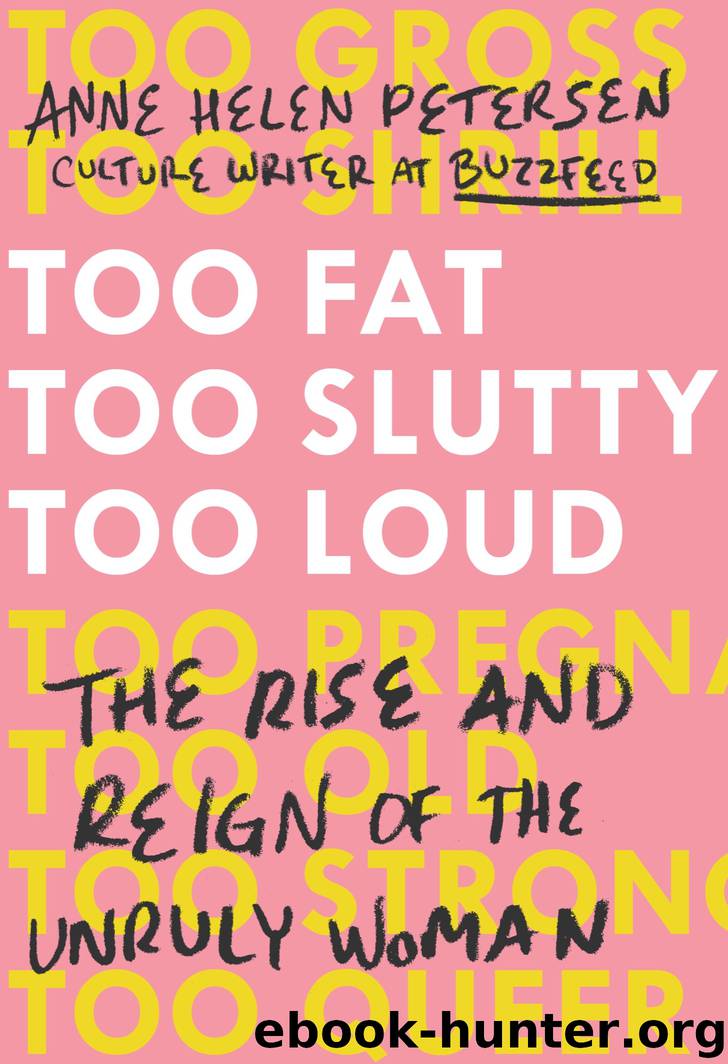
Author:Anne Helen Petersen
Language: eng
Format: epub
Publisher: Penguin Publishing Group
Published: 2017-05-15T17:45:42+00:00
CHAPTER 7
TOO SHRILL:
HILLARY CLINTON
Not to be sexist, but it is what it is,” Dennis, a sixty-three-year-old teacher from Stillwater, Oklahoma, told Esquire. “I do not trust that she, a woman, would be able to do what a man could with the same capabilities.” Dennis was one of dozens of men, of various ages and vocations, surveyed by Esquire as to their opinion of Hillary Clinton for their February 2016 issue. And while these men differed in their opinion of Clinton, their comments share a common ideological core. Sometimes, as in the quote above, they disavow sexism before explicitly engaging it. In other comments, their dislike is more subtle: “I don’t think she has mastered the art of becoming a warm, likable person to the American public,” says Jeremy, a fifty-eight-year-old CEO from Albuquerque, New Mexico. “To me, she comes across as cold and stiff.” Or this quote, from Russell, a fifty-seven-year-old farmer from Sumter, South Carolina: “There’s just something about her personality—it’s a little abrasive and a little arrogant,” he explained. “You know, after so many years of Hillary, it’s like, ‘Oh, go away.’”1
Over the course of her public life, Clinton’s been called unlikable and uncharismatic, bitchy and ball-busting—all expressions, in some way, that imply unruliness. For many, she is a nexus of disgust, a vector through which all anxieties about the changing world flow. With good reason: Hillary Rodham Clinton has spent her adult life being first. She was the first female partner at her law firm, the first professional woman to take the role of First Lady. And until a stunning upset by Donald Trump, she was slated to become the first female president.
While the other unruly women in this book have learned to tread a narrow lane of acceptability, Clinton’s lane been attenuated to a tightrope. She should be assertive but not bossy, feminine but not prissy, experienced but not condescending, fashionable but not superficial, forceful but not shrill. Put simply: she should be masculine, but not too masculine; feminine, but not too feminine. She should be everything, which means she should be nothing.
That Clinton has weathered more than two decades of these critiques is a testament to her resilience and fortitude. And her endurance has paid off: for the 2016 election, Clinton was able to find a foothold, and something like sympathy, among the voting public—in large part due to twenty-five years of accumulated sexism. The combination of an openly misogynist opponent and Clinton’s undeniable qualifications prompted both journalists and voters to question the standards by which politicians are judged—standards that are unquestionably masculine. What had previously felt like a smattering of objections and disappointments about her treatment by opponents, the press, and voters coalesced into something substantive and persuasive, with bite of its own. It felt like a reckoning—even if, as we now know, it was false hope, like celebratory fireworks that distracted from the fact that the house was getting torched.
“Shrillness” is just a word to describe what happens when a woman, with her higher-toned voice, attempts to speak loudly.
Download
This site does not store any files on its server. We only index and link to content provided by other sites. Please contact the content providers to delete copyright contents if any and email us, we'll remove relevant links or contents immediately.
| Anthropology | Archaeology |
| Philosophy | Politics & Government |
| Social Sciences | Sociology |
| Women's Studies |
Cecilia; Or, Memoirs of an Heiress — Volume 1 by Fanny Burney(32523)
Cecilia; Or, Memoirs of an Heiress — Volume 2 by Fanny Burney(31928)
Cecilia; Or, Memoirs of an Heiress — Volume 3 by Fanny Burney(31912)
The Great Music City by Andrea Baker(31894)
We're Going to Need More Wine by Gabrielle Union(19019)
All the Missing Girls by Megan Miranda(15881)
Pimp by Iceberg Slim(14461)
Bombshells: Glamour Girls of a Lifetime by Sullivan Steve(14036)
For the Love of Europe by Rick Steves(13792)
Talking to Strangers by Malcolm Gladwell(13327)
Norse Mythology by Gaiman Neil(13312)
Fifty Shades Freed by E L James(13214)
Mindhunter: Inside the FBI's Elite Serial Crime Unit by John E. Douglas & Mark Olshaker(9283)
Crazy Rich Asians by Kevin Kwan(9256)
The Lost Art of Listening by Michael P. Nichols(7475)
Enlightenment Now: The Case for Reason, Science, Humanism, and Progress by Steven Pinker(7287)
The Four Agreements by Don Miguel Ruiz(6726)
Bad Blood by John Carreyrou(6597)
Weapons of Math Destruction by Cathy O'Neil(6243)
